
Investigation – DITA
The criteria for the appointment of an investigator of the National Bureau of Investigation are strong, so strong that not all claimants manage to fulfill them. This is normal. This is how it should be.
The BKH is not an ordinary administrative unit, but the structure that must carry on its shoulders the most sensitive investigation in the country, in direct cooperation with the Special Prosecution. Precisely for this reason, the criteria for its leader must be even higher.
But how should the criteria for the selection of the chief investigator, the head of the BKH, be? Should he fulfill them with the grade 10? Not necessarily in the formal sense of the word, but, without doubt, he must come out the best among the best. He must be the candidate who convinces everyone, not only with CV, not only with a network of references, but with result, with ranking, with integrity and with unquestionable professional weight.
Because, if the testing in writing and orally, where are included cognitive, behavioral and logical reasoning tests; the written test that measures the abilities of drafting and the level of writing of reports, together with the physical abilities and those of verbal communication, come out below the average of almost all other candidates, how can be declared winner the one who comes out last in ranking among the candidates who have passed the phases?
With what unit of meritocracy does the SPAK Commission function? With what metric does afterwards the whole KLP function, when it accepts this overturning of the ranking as if it were the most normal thing in the world?
All investigators of the BKH are obliged to take a passing grade in each of the numerous tests that the law foresees for their appointment. And they have this as an obligation not only at entry, but also during the stay in duty. It is a condition of their professional renewal, just as it is also the obligation to undergo the polygraph test in a periodic way. For a simple investigator the standard is of iron.
Then how can it be accepted that for their leader the standard becomes elastic, unclear, movable and in the end overturned?
A recommendation can be attached to a CV. Everyone has had the case to use a motivation letter or a recommendation letter to start a job. There are written the proper references from people who confirm your experiences and your abilities. But this, usually, is not enough. The employer sees you, asks you, interviews you. He must convince himself, beyond the recommendation. He must see the result with his own eyes and take upon himself the responsibility of the choice.
But what did the “employers” of the KLP do with the head of the BKH? Instead of behaving as the appointing body, which verifies, compares, reasons and afterwards decides, they behaved like a protocol office that takes a ready decision and passes it further.
Procedure, in few words, was this:
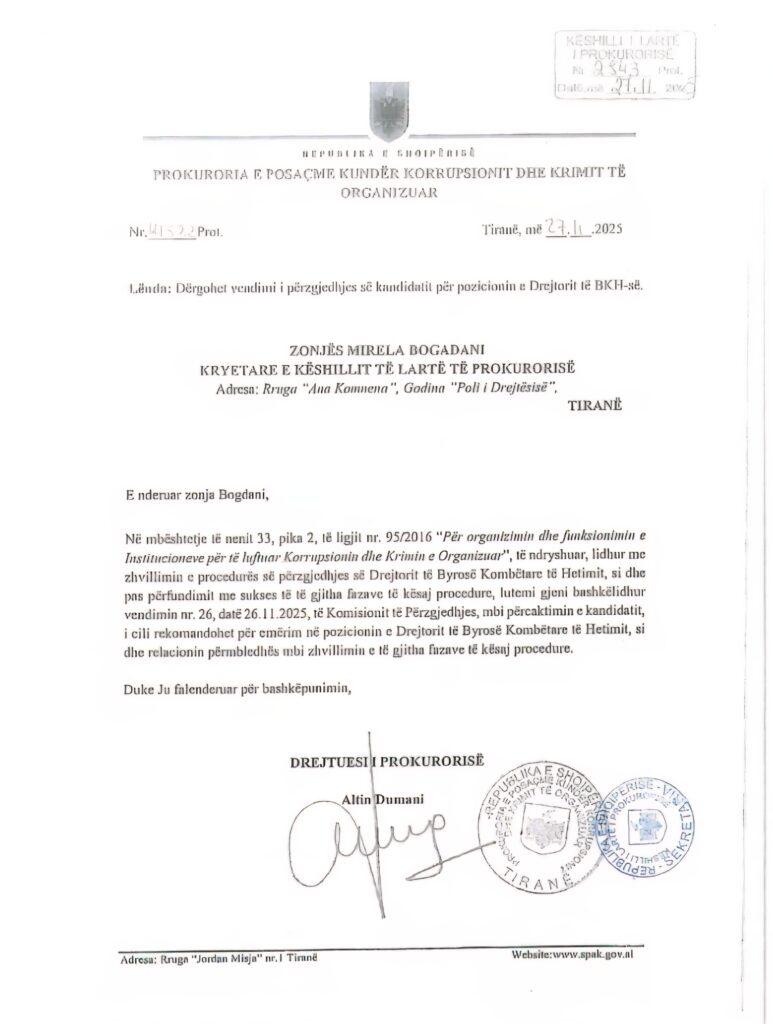
SPAK developed the competition, carried out the testings, ranked the candidates, took into review the reports and in the end sent to the KLP not only the recommendation, but also its decision ready. KLP, which according to the law is the appointing body, should have exercised its constitutional and legal weight. It should have convinced itself. It should have asked itself. It should have verified itself, in the institutional sense of the responsibility that it carries.
But from the way the process has been developed, a strong impression is created that KLP has been treated as a notary of SPAK, not as a body on its own.
SPAK has been built as the elite structure of the new justice. BKH is the tip of its spear, the helmet of the hero of this new institutional architecture. For this reason, the selection of its leader cannot be done with the logic of the human resources office of an ordinary administration, even less with overturned arithmetic, where six or seven is called one and the one is placed after.
Albania, with the successive governments, has excelled in one sector: that of paying two persons for the same job position. The financial effects that have burdened the state budget, from the year 2008 until 2025, are incalculable, regarding the administrative irresponsibility, where the civil servant or the state employee is thrown into the street, for another to be taken with party card, while the court gives “return” to work to the one who left.
By hundreds, maybe by thousands, decisions of the judiciary are for return to the workplace and for the carrying out of payments until the moment of return, a moment which often does not come early, or does not come ever.
In the budget of the Ministry of Finance every year are foreseen funds for the execution of court decisions, where millions are disbursed for the unjustly “dismissed”, who have won a return with court decision. No one holds responsibility for this. The chief who dismissed them, either has been dismissed himself, or has gone to another duty, or, in the most ironic case, has ended up in SPAK.
Now the risk is that this old story of the Albanian state is transplanted right in the heart of the institution that was raised to fight precisely these deformations.
The candidate for head of the BKH, the one who results winner according to the points, has sent the recommendation of the Selection Commission, together with the decision of the KLP that did not respect the scoring and the declared ranking, to the Administrative Court.
The decision and the recommendation will be evaluated by the court. If it decides to give right to the complainant, thus to the candidate who has come out winner by points, then we will enter into an absurd scenario: either we will have a new head of the BKH, or we will have two heads, where one holds the post, while the other wins the right and the salary.
BKH will become like a helmet with two heads: one a gift from the KLP and the other from the Court.
Why should this happen?
Why should an institution that was built to be the model of legality produce already at the top such a crisis of legitimacy?
Why should the son of the Ethics advisor near the KLP be placed in such a public position, where upon him weighs not only the burden of his own name, but also the shadow of suspicion that he is not there from pure merit?
Why should the colleagues, friends, collaborators or subordinates of yesterday of his father be placed in such a difficult position, that their decision looks more like a personal favor than an institutional act?
Whom does this serve? Himself? The institution? Justice? Or only a network of relationships that should never have entered this process?
For the first time in the small history of SPAK is documented such a pact, which leaves at least a heavy smell of illegality and institutional inappropriateness.
A silence for the friend, or an obligation for the enemy? This must be explained by those who call seven one and place one after seven.
At the center of the debate is not only one name. It is the model. It is the precedent. It is the message that is given to the new investigators, the new prosecutors, the public and the international partners themselves. What is told to them?
That you can be tested, ranked, measured and evaluated in five phases, but in the end wins not the one who comes out first, nor the one who convinces more with result, but the one who passes into a sixth filter, which is not measured with figures, cannot be compared, cannot be weighed publicly and cannot be explained convincingly?
This is the point where meritocracy ends and the problem begins.
The rich family and social CV
Beyond a CV which, according to many observers, does not bring any outstanding professional distinction in relation to the other higher-ranked candidates, the public profile of Joni Keta is accompanied also by a visible family and social baggage, which makes even more necessary the institutional care to avoid any favoring perception.
Precisely because the position is extremely high and its symbolic weight is extraordinarily big, every shadow of suspicion should have been avoided from the beginning.
From sources of the editorial office, Joni Keta is the son of the prosecutor Hysen Keta, currently in the position of Ethics advisor near the KLP. Hysen Keta is the son of the well-known figure Myslym Keta.
His spouse is Majlinda Keta (Shaqiri), former well-known exponent of the Socialist Party, as well as the sister of Bahri Shqiri, former head of SHISH and one of the close collaborators of former president Ilir Meta.
These connections, in themselves, do not constitute fault and neither can serve as public punishment for anyone.
But precisely because they do not constitute fault, the institutions should have been even more careful that there should not be created the impression that the family, institutional and social network is doing what the points could not do.
Also, according to the same sources, in the family circle is mentioned also a connection with business. The sister of Joni Keta, Stela Keta, is the spouse of Alban Peza, a relative of the Peza family, a well-known name in entrepreneurship. This too, in itself, does not prove anything illegal.
But when it is spoken about the leadership of the BKH, the issue is not only the formal cleanliness; the issue is also the appearance of cleanliness, thus the public trust that no one was raised to that position from the power of the surname, of the connection, of the phone call or of friendship, but only from the power of merit.
Also the composition of the KLP, in this viewpoint, deserves special attention. Members such as Ledina Riza (Lera) and Sokol Stojani, both career prosecutors, have been for a long time colleagues with Hysen Keta in the General Prosecution and in the Prosecution of Tirana. Employees of these institutions, according to sources of the editorial office, confirm a close acquaintance and consolidated professional and personal relationships.
Even these circumstances, taken separately, are not proof for a consumed conflict of interest. But taken together with the overturned result of the competition, with the suspicious relation between the recommendation and the appointment, and with the lack of a convincing reasoning for the selection of the last-ranked candidate, they create a picture that requires public, serious and full explanation.
Because justice is not measured only by the decision that it takes, but also by the way its decision appears in the eyes of the public. And here the appearance is as heavy as the content.
In the end, the question remains simple and merciless:
If the candidate who has come out weaker in the comparative ranking among those who passed the phases, can become winner in the end without a strong, detailed and verifiable explanation, then for what did all the tests serve? For what did the points serve? For what did the competition serve?
And above all, what guarantee does today the public have that the future head of the BKH has been chosen because he was the best, and not because he was the most connected?
If the answer to this question is not given quickly, clearly and with documents, the damage will not remain only at one contested appointment. The damage will fall on the very moral foundation of SPAK, on the trust in BKH and on the idea that the new justice was built not to repeat the old vices of the Albanian state.
FACSIMILE EVIDENCE:
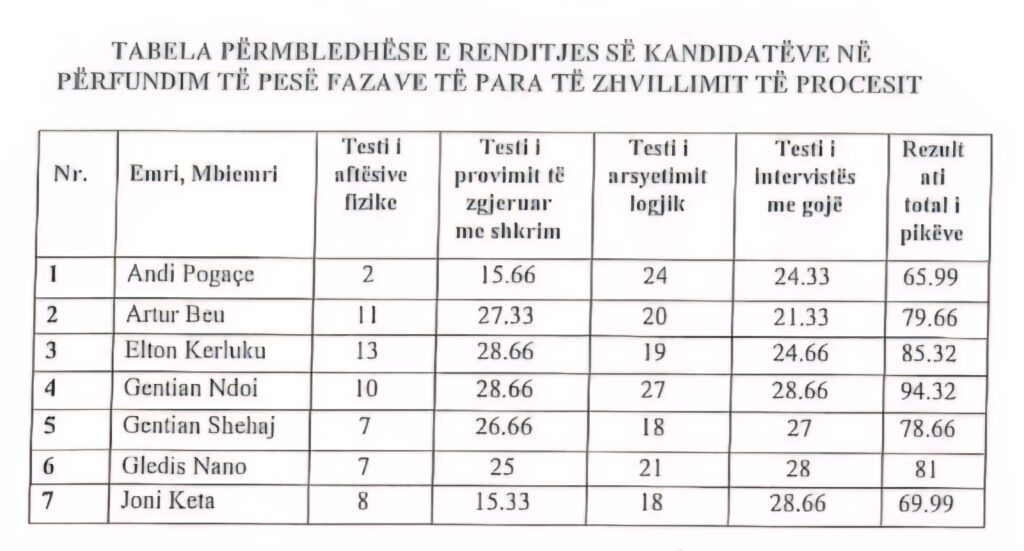
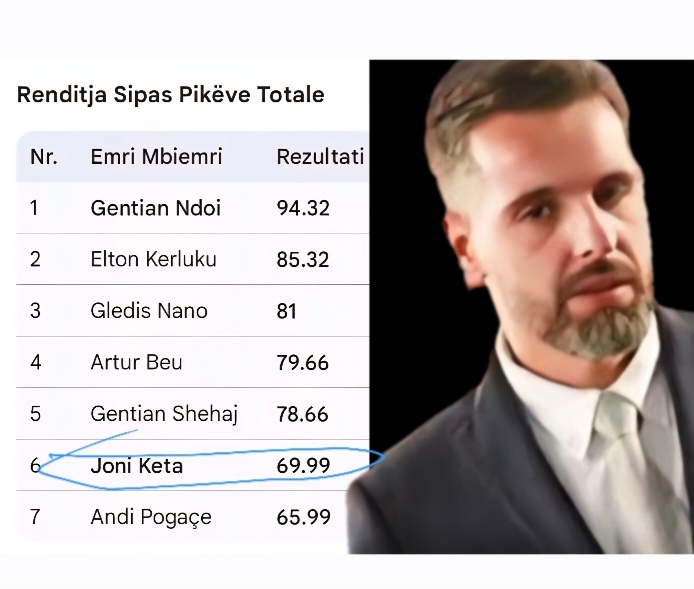
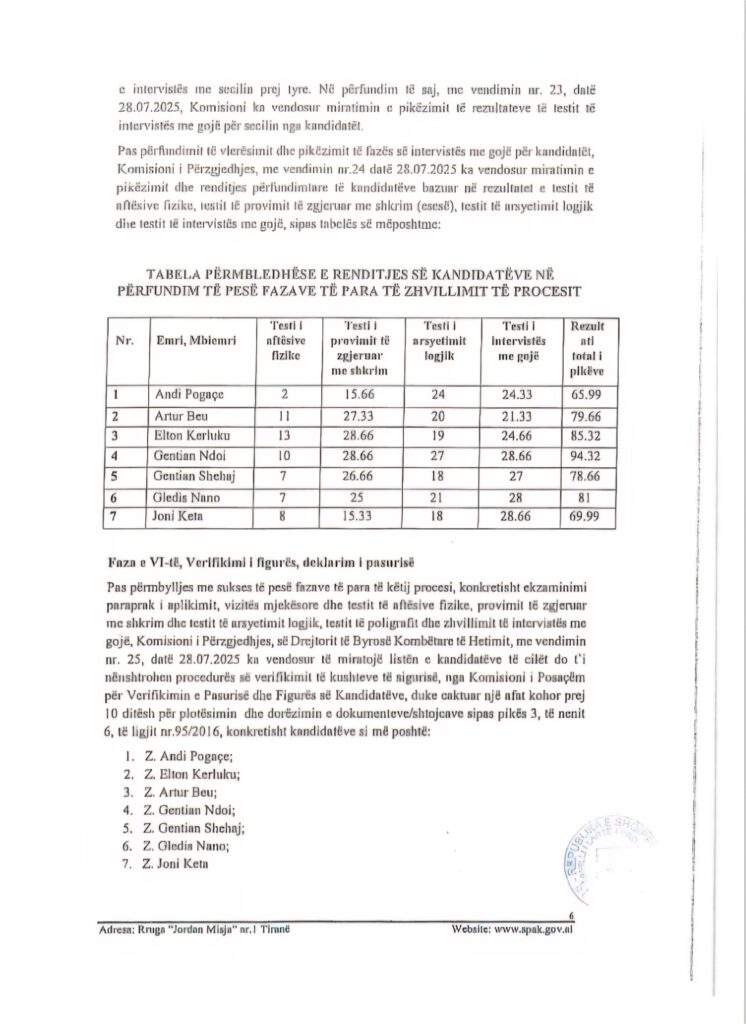
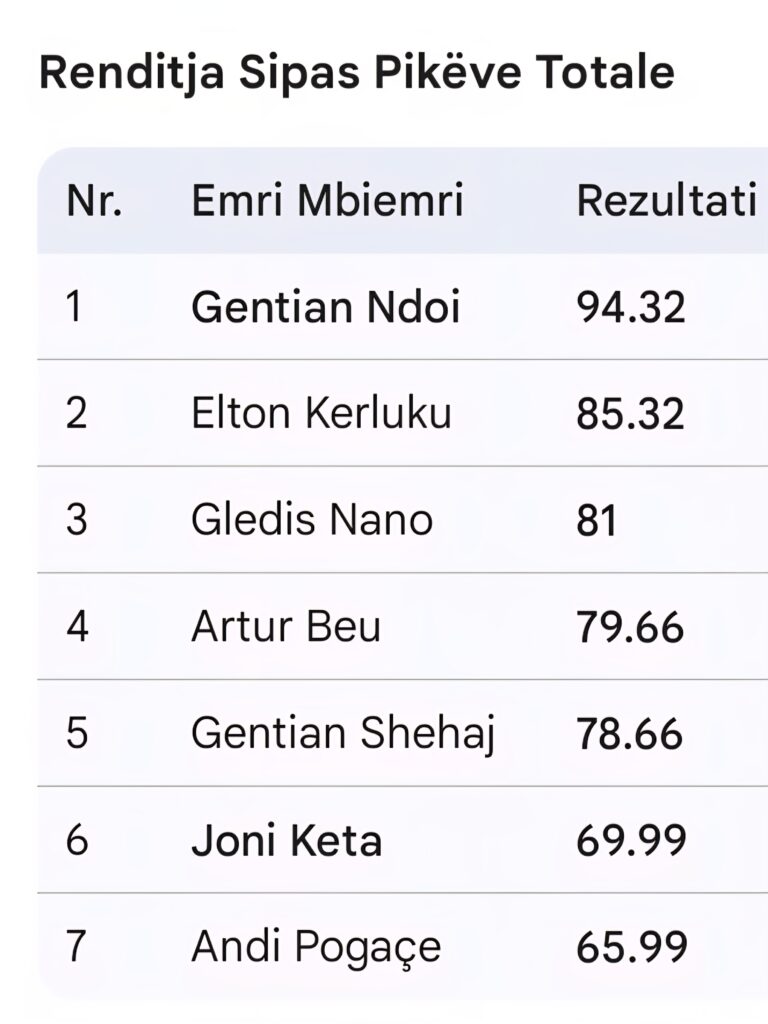
Based on the above table which is an official document from the file of the selection of the head of the BKH, it results that Joni Keta declared winner, not only is not the first, but is ranked almost at the end of the list of total points.
A simple analysis of the real ranking according to the figures that this official table reflects, proves that Joni Keta has a difference of 24.33 points less than Gentian Ndoi, who leads the list.
Keta has the weakest result (together with Andi Pogaçe) in the “Extended written examination test” with only 15.33 points, while the other competitors have almost double (over 28 points).
Even though he has come out well in the oral interview (28.66), this does not compensate the big loss of points in the written test and in the logical reasoning test (where he has only 18 points).
If Joni Keta has been selected for the position in question, this table clearly proves that the selection has not been based on the meritocracy of the points declared here, since he is ranked second to last (6th out of 7 candidates).
©️Copyright Gazeta DITA
This article is exclusive of Gazeta DITA, enjoys the right of authorship according to Law No. 35/2016, “On copyright and related rights”. The writing may be republished by other media only by citing DITA and at the end placing the link of the source, according to Article 178 of Law No. 35/2016.
