

Investigation – DITA / Part II
Has the constitutional and legal separation between the body that recommends and the body that appoints been respected, has the verification of assets and background actually been carried out according to the law, and has the scoring system been used as a real meritocratic instrument or only as a formal cover of a predetermined decision-making?
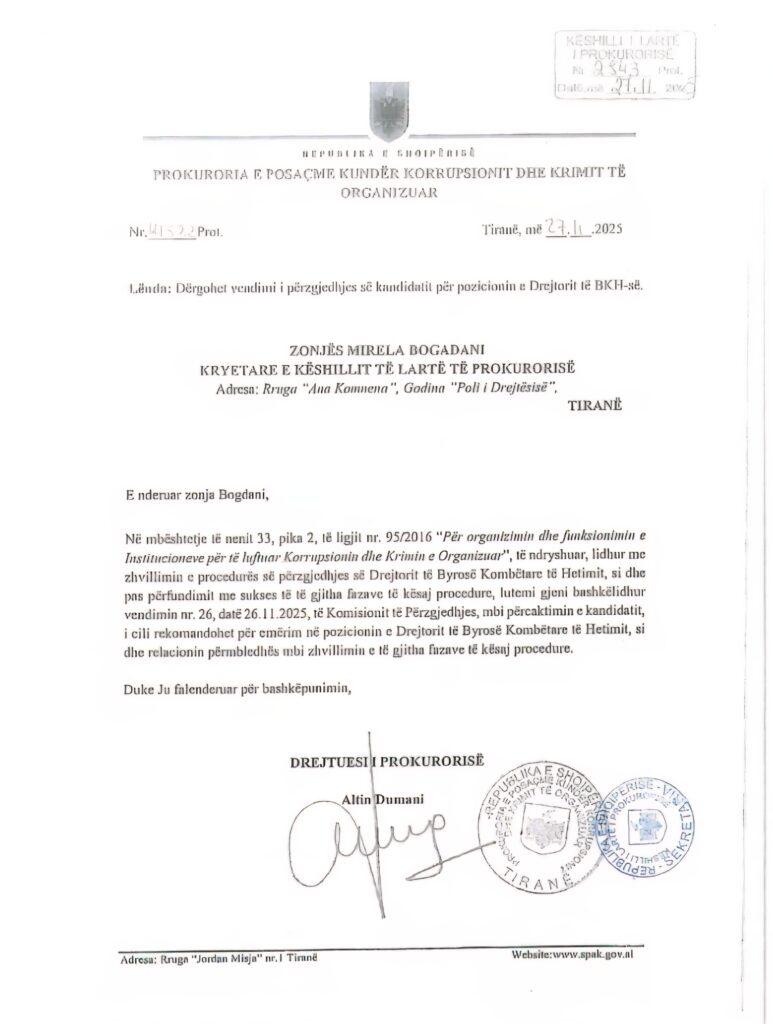
From the relation itself and the decision of the Selection Commission, dated 26.11.2025, it results that the SPAK Commission has carried out the procedure in six phases, has administered the testings, has received the verification reports and, in the end, with decision no. 26, has decided to recommend to the High Prosecutorial Council the candidate Joni Keta for appointment as Director of the BKH.
From the accompanying letter it also results that SPAK has sent to the KLP not only the summary relation, but also the very decision of the selection of the candidate. This very way of proceeding raises immediately the fundamental legal question: where does the competence of SPAK begin and where does it end, and what real competence remains for the KLP?
Law no. 95/2016 has resolved clearly this division. Article 33/2 foresees that the commission composed of the Head of the Special Prosecution and two special prosecutors “recommend a candidate”, while that same candidate “is appointed by the High Prosecutorial Council”.
The same norm distinguishes in a clear way the function of the commission as a selecting/recommending body from the function of the KLP as an appointing body. The law does not say that SPAK appoints and KLP formalizes; on the contrary, the law says that SPAK recommends and KLP appoints.
This is not a terminological difference, but an essential division of competences.
From this starting point, the main legal consequence immediately comes out: KLP cannot be treated as a notary of SPAK. If the procedure has been carried out in such a way that the SPAK commission not only administers the competition, but also selects the winner in the material sense, while to the KLP is sent the ready decision for approval, then we have an unlawful shift of the center of decision-making from the appointing body to the recommending body.
This would be in direct contradiction with article 33/2 of law no. 95/2016, because it would empty the competence of the KLP from real content and would turn it into a formal link of ratification.
This problem becomes even more serious when it is read together with article 148/dh, point 5, of the Constitution. The Constitution foresees that the candidate for prosecutor, investigation officer, administrative personnel of the Special Prosecution and the Special Investigation Unit, as well as his close family members, before appointment, are subject to verification of assets and background, according to the law.
This means that the verification of assets and background is not an internal preliminary formality of the commission, but a constitutional condition necessary for the validity of the appointment. In systematic reading with article 33/2, this constitutional norm strengthens the conclusion that the verification must be institutionally linked with the body that will take the final decision of appointment.
Here enters into play article 6 of law no. 95/2016, which has decisive importance. This article foresees that the candidate for director and investigator in the National Bureau of Investigation must fulfill the security conditions and the fulfillment of professional ability before being assigned to duty. These conditions include, among others, the control of verification of assets and background.
Further, this same article determines that the Special Commission for Verification of Assets and Background of Candidates, after receiving from the “relevant institutions of appointment” the declarations of the candidates, carries out the verifications and, within 120 days, delivers to the institution of appointment a detailed report on the legality of the sources of assets and the cleanliness of background, together with the supporting documentation.
This provision is, in fact, the central knot of the problem. For the Director of the BKH, the “institution of appointment” is the High Prosecutorial Council, not SPAK. SPAK, in this procedure, is not the appointing body; it is the recommending body.
Therefore, in correct and systematic interpretation of the law, the declarations submitted for purposes of verification and the final report of the Special Commission must be administered in the file of the appointing body and be examined by it before decision-making.
Precisely here it seems that stands one of the most serious violations of the procedure that comes out from the SPAK relation: the relation says that the documentation has been sent, that the reports have been received and that the Selection Commission has “taken them into consideration”, but does not clarify clearly when, how and in what form the full report of the Special Verification Commission has been administered by SPAK itself, while the KLP as appointing body has not even made it object of its own examination before voting this report.
If this phase has been practically consumed within SPAK, with the idea that the recommending commission can suffice with taking into consideration the reports and then bring to the KLP only the ready conclusion, then the law has been interpreted wrongly.
The law does not say that the Selection Commission replaces the KLP in the control of the security conditions; the law says that the Special Verification Commission delivers to the institution of appointment the detailed report. This formula does not leave space for relativization with internal regulations.
A regulation of SPAK can organize the selection procedure, but cannot change the legal address of sending for evaluation the verification report nor transfer the competence of substantial examination from the KLP to the “recommending commission”.
This makes problematic also the very way how the sixth phase has been constructed in the SPAK regulation. The regulation foresees that the process is carried out in six phases and among them, after the “verification of background” and “declaration of assets”, comes the phase of “identification of the winning candidate, training and proposal for appointment/reappointment”. The regulation adds that the final appointment is made by the KLP, with recommendation from the Selection Commission.
At first sight this may seem in accordance with the law; but the problem arises from the use of terminology and from its practical effect. Because if, before the matter goes to the KLP, the SPAK Commission has already identified the “winning candidate”, has taken the reports, has carried out the evaluation and has sent to the KLP also the ready decision, then the appointing body is placed before a finished product and not before a candidacy that must be verified and evaluated by it in a real way. Thus, the formulation “final appointment by KLP” risks to remain a formality, not a real exercise of competence.
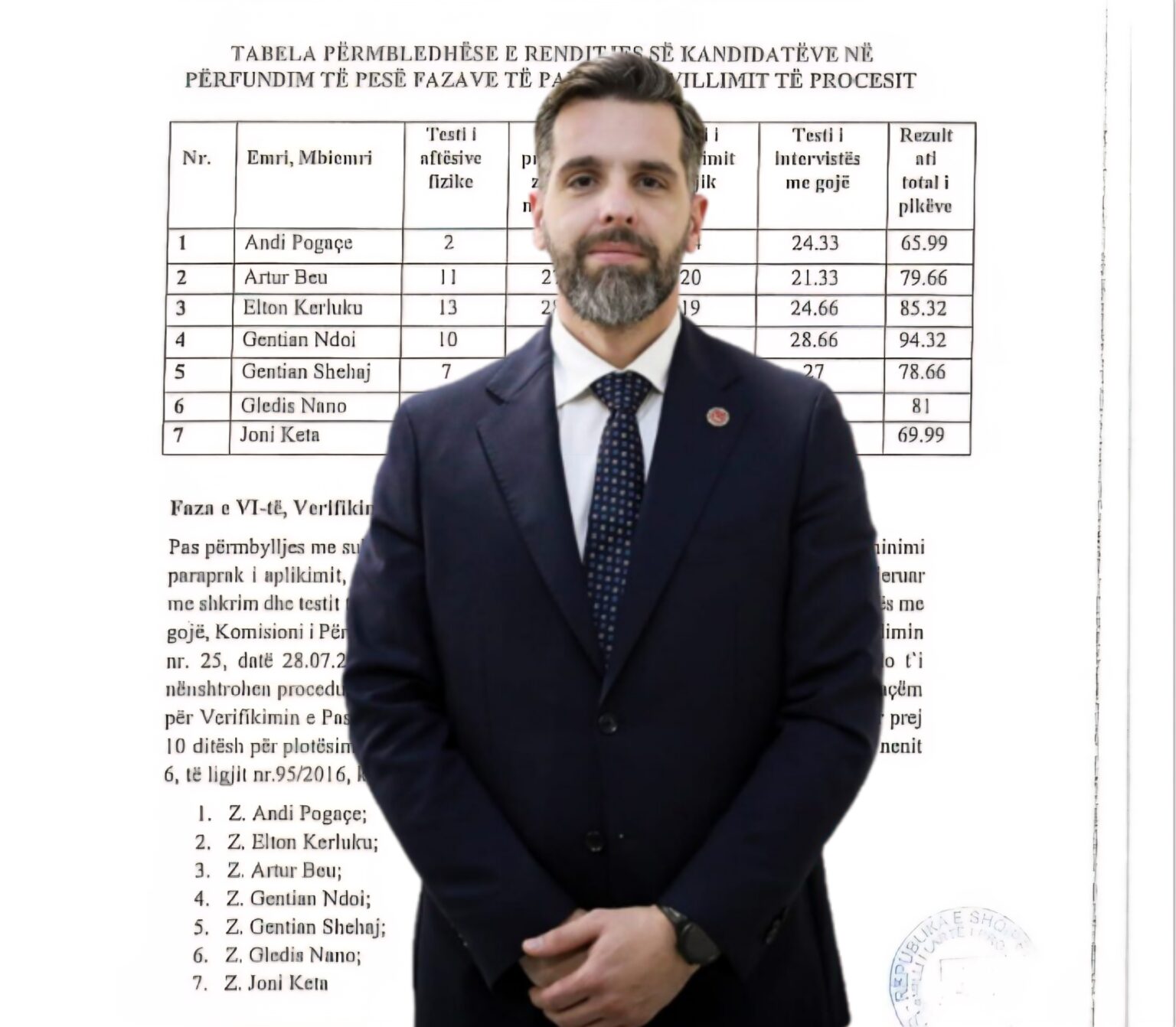
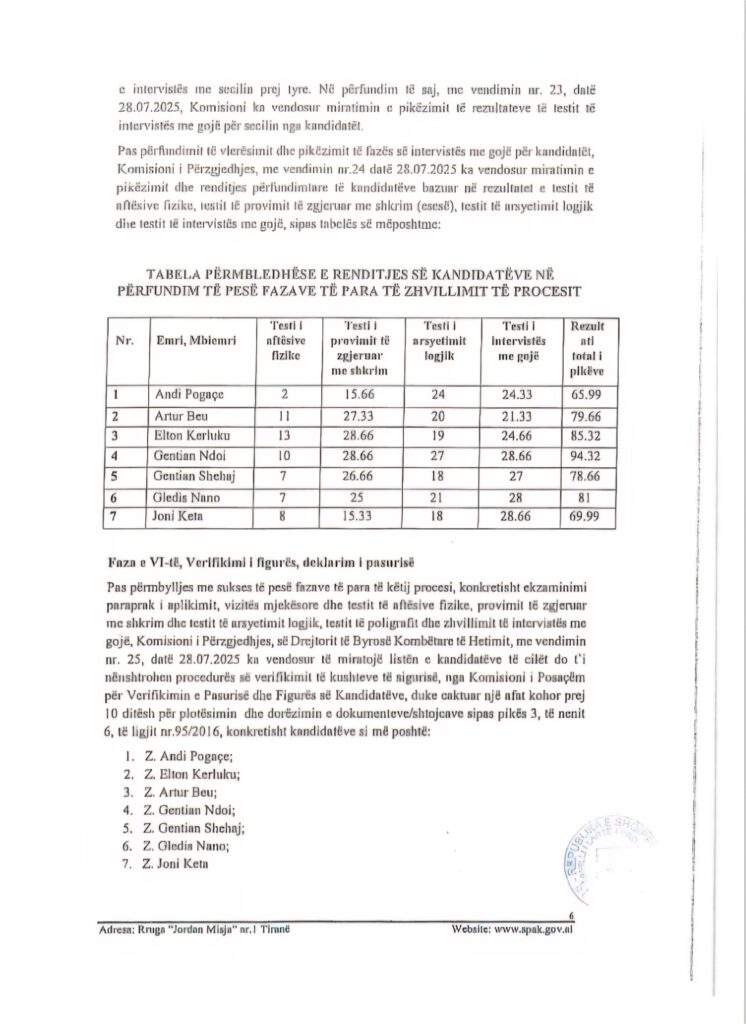
Another very strong element comes out from the scoring table itself that is found in the relation. There is reflected the ranking of the candidates at the end of the first five phases. According to this table, Joni Keta results with 69.99 points, while other candidates result with clearly higher points: Gentian Ndoi 94.32, Elton Kërluku 85.32, Gledis Nano 81, Artur Beu 79.66, Gentian Shehaj 78.66.
Afterwards, in the phase of verification of background and assets, from seven candidates only one — Gledis Nano — results that does not fulfill the security conditions, while the other candidates, including Joni Keta, result that fulfill them. After this, the Commission decides to select precisely Joni Keta.
This is the moment where arises the strongest logical and legal contradiction of the whole process.
If the procedure is built on tests, scoring, ranking and total result, then the points must have a real function in the final selection. Otherwise, a procedure is created only in appearance meritocratic, while in essence the decision-making remains unsupported on the objective standards that the commission itself has declared and applied.
It is not necessary that the law explicitly say “the candidate with the most points wins” for this conclusion to be legally reasonable. It is enough the fact that SPAK itself has built an entire comparative procedure, with testing and scoring in several phases, to create the obligation for special and convincing reasoning when the recommended candidate is not the highest-ranked candidate and, moreover, is after several other candidates who have passed the phases with significantly superior result.
Precisely here the SPAK relation does not give sufficient explanation. It describes the phases, lists the points, lists the conclusions of verification and then passes to the conclusion that the commission, “after overall examination of the entire process”, decided the selection of Joni Keta. This formula is too general to justify the surpassing of the numerical ranking. It does not clarify:
• why the candidate with 69.99 points was considered more suitable than candidates with 94.32, 85.32 or 79.66 points;
• which concrete qualitative elements of the verification of background and assets weighed in his favor in relation to the others;
• whether there was any prior standard that turned the first phase of scoring simply into a passing filter and not into a ranking criterion; and above all,
• what was the legal relation between the numerical result and the final decision.
Without this reasoning, the decision normally appears exposed to the accusation of arbitrariness. Not because the commission is necessarily mechanically obliged by the points, but because, once it chooses to build a competition with points and ranking, it cannot disregard that ranking without giving full, specific and verifiable explanation.
Otherwise, the principles of transparency, objectivity and equal treatment of candidates are violated.
This is directly related also with article 33/3 and article 34 of law no. 95/2016. Article 33/3 says that the candidate cannot be assigned to duty as Director of the BKH without fulfilling the security conditions and the conditions of professional abilities.
Article 34/1 adds that the candidate must successfully fulfill the criteria of selection and training. These provisions imply that “professional abilities” cannot remain an abstract notion, but must come out from the objective procedure of selection itself.
When scoring exists, this is the clearest indicator of comparative professional ability. Therefore, in the absence of a specific reasoning that shows why the candidate with lower points was considered in the end the most suitable, the finding that he “fulfills the conditions of professional abilities” remains declarative and insufficiently supported on the administered facts.
Equally serious is also another problem that comes out from the relation: the way how the verification of assets and background has been treated. SPAK says that on 15.08.2025 it has sent to the Special Commission for Verification of Security Conditions of Candidates all the relevant documentation officially deposited by each candidate; afterwards it says that on 25.11.2025 the respective verification reports for seven candidates have been forwarded and are given only the short conclusions of who “fulfills” or “does not fulfill” the security conditions.
This way of presentation is not complete for a procedure of this level. The law does not require simply a binary conclusion “yes/no”; it requires a detailed report on the legality of the sources of assets and the cleanliness of background, with supporting documentation.
If the KLP has been called to vote only on the basis of a summary relation of SPAK and not on a direct and full administration of the detailed report of the Special Commission and every documentation administered during the competitive process, then the appointing body has not actually exercised the control that the law assigns to it.
This is also the reason why the claim that “SPAK has itself done the verification” does not stand legally as a sufficient answer. SPAK may have administered the procedure, may have coordinated the phases and may have taken knowledge of the reports, but this does not legally replace the role of the KLP as appointing body.
The law does not use by chance the expression “institution of appointment”; on the contrary, precisely to avoid the concentration of all filters and decision-making in one single hand, it separates the body that recommends from the body that appoints and links the in-depth verification with the file of appointment.
In this prism, the way how SPAK has sent to the KLP also its own decision of selection constitutes another problematic element. The issue is not the sending of an accompanying act as such; the issue is that, when this act already contains the identification of the “winning candidate”, and when the relation summarizes the phases in a way that presents the choice as materially completed, then over the KLP weighs the risk of an institutional pressure to act as a formal body.
This significantly weakens the idea of an autonomous decision-making of the KLP and reinforces the perception that SPAK has exercised not only the right to recommend, but de facto also the right to determine the appointment.
Another issue, which must be treated with care but also with full seriousness, is that of conflict of interest in the KLP. Law no. 115/2016, in article 171, obliges the member of the Council who is in conflict of interest or in knowledge of a legal impediment to declare the nature of the interest, not to participate in discussion and not to participate in voting.
This norm does not protect simply the formality of the decision; it protects the objective impartiality of the collegial body and the trust of the public in the procedure. Therefore, if the conflict of interest has existed and has not been declared and managed according to the law, this would seriously affect the validity of the decision-making.
In conclusion:
First, the procedure appears to have deformed the legal separation between SPAK as recommending body and KLP as appointing body, risking to turn the latter into a formal approver.
Second, the verification of assets and background, which according to the Constitution and article 6 of law no. 95/2016 must function as a real condition before appointment and be linked with the institution of appointment, does not result reflected with the required transparency and completeness in the file and reasoning of the decision-making.
Third, the scoring and ranking system has been used in a way that produces a strong contradiction between the objective result of the candidates and the final result of the recommendation, without a specific reasoning that justifies it.
Fourth, the link between “professional abilities” and the accumulated points remains unclear, making the conclusion on the professional suitability of the winning candidate appear insufficiently supported.
Therefore, the procedure followed for the selection and appointment of the Director of the BKH presents substantial violations of the law and of the constitutional standard of appointment, because it has weakened the role of the appointing body, has relativized the legal function of verification of assets and background, has disregarded without sufficient reasoning the comparative result of scoring and, as a consequence, has affected the credibility, objectivity and legality of the entire process.
©️Copyright Gazeta DITA
This article is exclusive of Gazeta DITA, enjoys the right of authorship according to Law No. 35/2016, “On copyright and related rights”. The writing may be republished by other media only by citing DITA and at the end placing the link of the source, according to Article 178 of Law No. 35/2016.
Part I of this investigation can be read by clicking HERE.
